

B2B Content Strategy That Drives Results: 10 Proven Steps to Grow Traffic, Leads, and Revenue
A strong B2B content strategy is the difference between content that collects dust and content that drives measurable growth. The most successful teams use documented goals, buyer-centric messaging, and consistent distribution to convert content into traffic, leads, and revenue. This guide outlines 10 proven steps to help you achieve the same results.

If you’re in B2B marketing right now, you’re feeling the squeeze. Budgets are under pressure, buyers are harder to reach, and the expectations for content are higher than ever.
Everyone wants proof that the time and money invested in content is actually moving the needle. Meanwhile, only 29% of B2B marketers say their content strategy is “extremely or very effective.”
Yet, many organizations still treat content as a box to tick, instead of the engine that drives sustained growth.
Here’s the reality: without a clear B2B content strategy, your efforts are almost guaranteed to stall. Additionally, according to the Content Marketing Institute, only 28% of B2B marketers report feeling successful in delivering the right content to the right audience at the right time.
That’s a staggering gap between effort and outcome. And if you don’t close it soon, you risk pouring resources into a “content graveyard” where assets collect dust instead of generating leads, traffic, or revenue.
So why is it so hard to get content strategy right?
Part of the problem is that content lives at the crossroads of brand, product, sales, and digital marketing. Everyone has an opinion, but no one has a unifying plan.


Another issue is that the buyer journey has shifted dramatically. Today’s B2B buyers do more than 70% of their research before ever reaching out to sales. If your content isn’t helping them at every step, someone else’s will.
But get ready for some good news.
With a deliberate and practical approach, you can build a content strategy that cuts through the noise and delivers actual results. It doesn’t require reinventing the wheel — just some clarity, consistency, and a willingness to rethink a few outdated assumptions.
Consider Your Challenge in Numbers
Before we get into the how, let’s ground ourselves in the why. Numbers don’t lie, and the numbers around content strategy are sobering.
For starters, 57% of B2B marketers admit they struggle to create content that resonates with their audience. Think about that: over half the content being published isn’t hitting the mark. That’s a massive amount of wasted effort.
And then there’s the issue of documentation. The same research indicates that 44% of marketers don’t have a documented content strategy. They’re publishing without a plan, hoping something sticks. It’s like running a marathon without a course map — you’ll burn energy but have no idea if you’re moving in the right direction.
Finally, consider this: 87% of B2B buyers expect relevant content at every stage of their journey. Not just at the awareness stage or the decision stage, but across the entire process. If you’re not providing it, they’ll turn to competitors who are.
In other words, the challenge isn’t a lack of effort. It’s a lack of alignment, consistency, and strategy. That’s where things need to change.
Rethinking What “Strategy” Really Means
One of the biggest misconceptions in B2B marketing is that “content strategy” just means creating more content. If you’ve ever been in a meeting where someone says, “We need more blog posts” or “Let’s launch a whitepaper,” you know how easy it is to confuse volume with value. But here’s the hard truth: more content doesn’t automatically equal more results.
In fact, creating too much without a plan often makes things worse. It spreads your team thin, dilutes your messaging, and clutters your website. The winners in B2B marketing aren’t the ones pumping out the most assets; they’re the ones building a repeatable system for getting the right content in front of the right people at the right time.
A B2B content strategy is not just a content calendar. It’s the framework that connects your goals, your audience, your messaging, and your distribution plan. When done well, it turns content from a scattershot effort into a revenue-driving machine.
And that’s where the 10 proven steps come in. These aren’t theoretical exercises or abstract ideas. They’re the practical actions that separate organizations that “do content” from those who actually drive measurable traffic, leads, and revenue.
10 Proven Steps to Build a B2B Content Strategy That Drives Results
1. Document Your Goals & Audience Clearly
The first step is deceptively simple: clarify your goals. Too many teams jump into tactics without deciding what success looks like.
Are you trying to generate qualified leads? Build brand awareness? Support sales enablement? Each of those goals requires a different mix of content, formats, and channels. Unless you’ve documented your goals and aligned your team around them, your content will always feel scattered.
2. Audit Existing Content (and Repurpose Smartly)
From there, it’s time to take stock of what you already have. Most companies are sitting on a goldmine of underutilized assets. A well-written whitepaper can become a series of blog posts. A popular webinar can be repackaged as a guide.
Instead of obsessing over creating net-new content, smart B2B marketing teams focus on repurposing and amplifying what’s already working.
3. Create Buyer-Centric Messaging
Next comes messaging. This is where many organizations stumble, because they focus on themselves instead of their buyers. A good B2B content strategy flips that perspective. It translates features into value, and value into stories.
If your content doesn’t make your buyer see themselves – their problems, their goals, their world – it’s not doing its job.
4. Map Content to Non-Linear Journeys
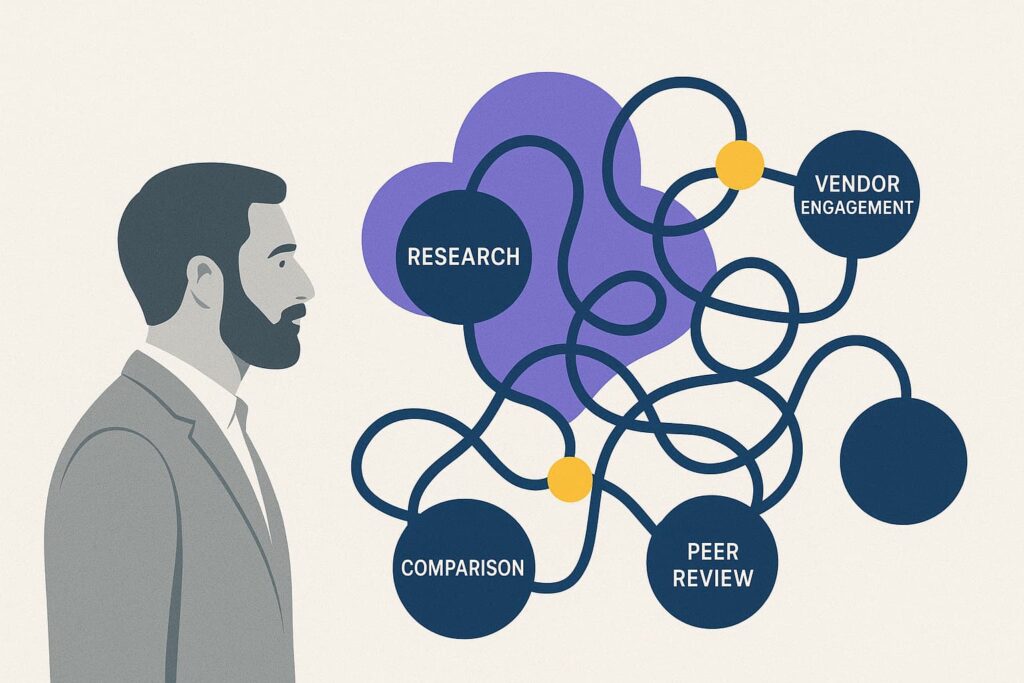
Let’s take a moment to discuss the buyer journey. Set aside the neat funnel diagrams you’ve seen in slide decks.
Real buyer journeys are messy, nonlinear, and self-directed. People loop back, skip steps, and ghost sales for months before re-emerging with new priorities. Your content strategy has to account for this reality. That means creating assets that can stand alone and still provide value, regardless of where the buyer enters.
5. Prioritize Distribution & Promotion
Distribution is another critical step that gets overlooked. Content without distribution is like a concert with no audience. You can’t simply hit ‘publish’ and expect results.
The most successful B2B SEO strategies pair organic search with paid promotion, social amplification, partnerships, and community building. In fact, distribution often matters more than creation. A single great article with strong promotion will outperform a dozen unpromoted posts every time.
6. Balance SEO with Human Value
Of course, SEO still plays a huge role. But the game has changed. It’s not just about keyword stuffing anymore; it’s about intent.
Google rewards content that genuinely helps people, and buyers do too. That’s why the best B2B SEO strategies blend optimization with authenticity.
Use the right phrases — like “lead generation B2B” or “content marketing B2B” — but never sacrifice clarity or trust for the sake of search engines.

7. Leverage Insights from Analytics
Analytics help close the loop. A B2B content strategy is only as strong as its measurement. If you don’t know which assets are performing, you can’t double down on success or cut out what isn’t working. The smartest teams treat analytics as their compass, not their report card.
8. Align Sales and Marketing
Don’t overlook internal alignment. Content that doesn’t connect with sales is content that gets ignored. Content that isn’t consistent across brand channels erodes trust. Content that isn’t revisited regularly tends to become stale. The best strategies are living documents, not one-time plans.
9. Build for Consistency (Not One-Offs)
In the B2B content strategy arena, many content plans have collapsed under the weight of inconsistency. A blog gets launched with three great posts, then silence. A newsletter goes out strong for a quarter, then fizzles. Buyers notice when you show up inconsistently — and they don’t stick around waiting.
The solution is to think in terms of systems, not one-offs. That means building editorial calendars, workflows, and realistic publishing cadences that your team can actually sustain.
Consistency compounds. Even if you publish once every two weeks, doing so reliably builds more trust and traffic than sporadic bursts of activity followed by radio silence. In content marketing, reliability is a form of differentiation in itself.
10. Experiment, Test, and Evolve
A B2B content strategy is never “finished.” Markets shift, algorithms evolve, and buyer expectations change more rapidly than most teams can keep pace with. What worked brilliantly last year may fall flat today. That’s why the best strategies leave room for experimentation.

Treat your content like a lab: test new formats (such as short-form video and interactive tools), try new channels, and pay attention to early signals in your analytics. Not every experiment will succeed, but each one teaches you something about your audience. The goal isn’t perfection — it’s evolution.
Teams that bake testing into their DNA avoid stagnation and stay ahead of competitors still clinging to outdated playbooks.
Use Aha Moments Like These to Get the Gears Turning
1. Content Isn’t King — Distribution Is.
Many marketers still cling to the notion that “content is king,” but the real differentiator is how well content is amplified and distributed. A blog post without distribution is like a billboard in the desert.
2. Conversions Are Better Than Traffic
Traffic alone isn’t success. 500 well-targeted visitors who convert into qualified leads are more valuable than 5,000 passive readers who bounce. Real growth comes from focusing on conversion and pipeline impact.
3. Repurposing Beats Reinventing
Many leaders underestimate the untapped value of existing content. Repurposing creates “always-on” content engines without burning out teams.
4. SEO Alone Isn’t Enough Anymore
With Google’s AI Overviews and increased competition, relying solely on SEO is a risk. Future-proof strategies combine SEO, social, and community-driven content to capture attention from multiple angles.
5. Your Buyer’s Journey Is Not Linear
The funnel is dead. Or at least, it’s no longer linear. Modern B2B buyers are navigating an ecosystem, not a straight path. Your content needs to be ready to meet them wherever they show up.
6. Quality Outpaces Quantity
Everyone says “quality over quantity,” but here’s the twist: quality is subjective unless tied to performance. The highest-quality content is not what you think looks polished — it’s what drives the intended behavior (click, share, signup).
Quick Wins You Can Start Applying Today
If this feels overwhelming, don’t panic. You don’t need to overhaul everything overnight. Start small. Audit your top five assets and see how they can be repurposed. Add one new distribution channel for your next campaign. Pull up analytics and identify your best-performing keyword, then double down with supporting content. These small moves compound quickly.
Summary & Key Takeaways
At the end of the day, a B2B content strategy isn’t about creating endless content or following the latest trend. It’s about building a framework that connects your goals, your buyers, and your story into something repeatable and measurable. Without it, your efforts will always feel scattered. With it, you can drive real growth in website traffic, leads, and revenue.

And here’s the part many people miss: you don’t need to do it all at once. You just need to start. Strategy grows in strength the more you use it. Each asset, each campaign, each distribution push builds on the last. Spark by spark, you create the kind of momentum that fuels sustainable growth.
That’s what separates content that gets ignored from content that drives results.

Want to Stay Ahead of Your B2B Competitors?
Every marketing professional faces pressure to deliver growth and prove ROI.
We’ve distilled insights from top-tier sources to create a strategic guide that helps leaders like you transform challenges into opportunities.
FAQs
What is a B2B content strategy?
A B2B content strategy is a documented plan that connects your business goals with buyer needs through targeted messaging, effective formats, and strategic distribution. It ensures your content attracts the right audience, supports their journey, and converts them into leads and revenue.
Why do B2B content strategies fail?
Most fail because they focus on volume over value, lack documented goals, and ignore the nonlinear buyer journey. Without clarity and consistency, content efforts scatter instead of building measurable results.
How can I quickly improve my B2B content strategy?
Start by auditing your existing content, clarifying your value proposition, and aligning copy with buyer journeys. Then, focus on distribution and test small changes, such as headlines or CTAs, to boost conversions.