

How Sharpening Your Value Proposition Can Increase B2B Sales
Increasing B2B sales starts with sharpening your value proposition. Buyers don’t purchase features — they buy outcomes. A clear, consistent value proposition helps prospects instantly see the benefits you deliver, shortening sales cycles and boosting conversions.

If you’ve ever been part of a B2B sales team, you know the drill: long sales cycles, stacked pipelines, endless follow-ups. And yet, deals stall.
Your product or service may be excellent, but the results aren’t matching the effort. The reason, more often than not, isn’t a lack of demand — it’s a muddled message.
Buyers need to instantly understand the unique value you deliver. If they don’t, they move on.
In other words, increasing B2B sales isn’t just about selling harder — it’s about selling smarter. And that begins with a clear and compelling value proposition.
The B2B Sales Challenge
B2B buyers are more informed and cautious than ever.
According to a HubSpot survey, 74% of buyers say that professional services websites influence purchasing decisions. Yet, SiriusDecisions found that 60–70% of B2B content created by companies never gets used by sales teams.
Translation: your potential buyers are out there, ready to engage, but your message isn’t connecting.
Fragmented messaging is a major culprit. Marketing may be promoting one set of benefits while sales communicates something slightly different — or worse, overly technical features that leave buyers scratching their heads. When your story doesn’t resonate, prospects hesitate, deals slow, and your sales numbers plateau.
This is where a value proposition comes in — not just any value proposition, but one that is sharply defined, benefit-driven, and consistently applied across all touchpoints.
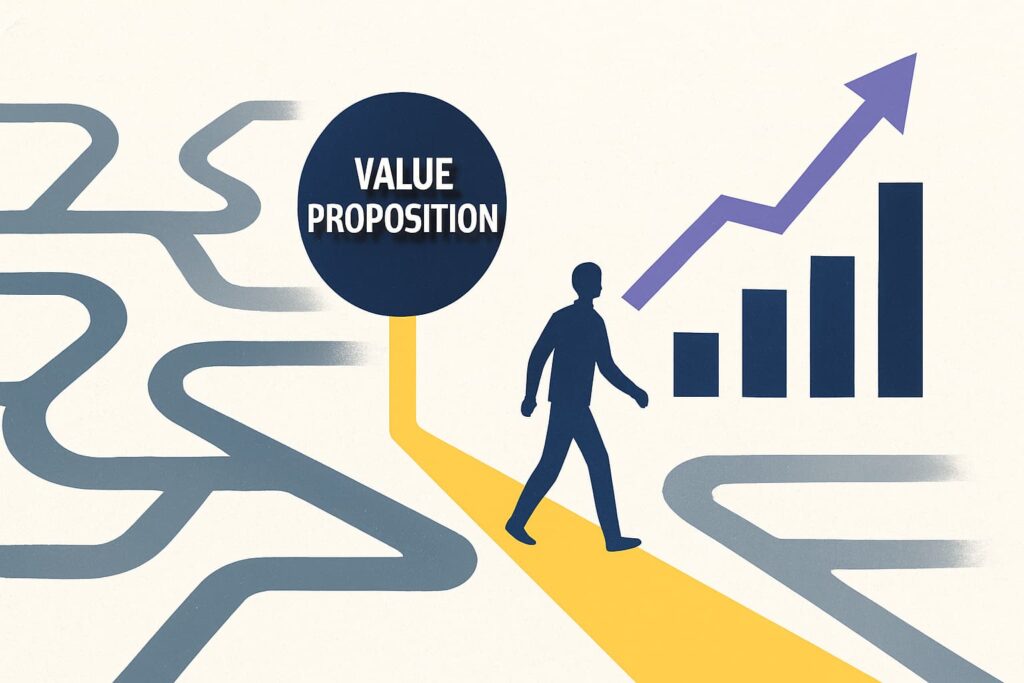
Famous Value Propositions in Action
Sometimes the best way to understand the power of clarity is through examples that stick in your head:
Apple: “Think different.”
One line that evokes innovation, simplicity, and aspiration.
FedEx: “When it absolutely, positively has to be there overnight.
Immediate clarity on reliability and speed.
Slack: “Be less busy.”
Communicates the tangible benefit in a way that resonates instantly with users.
In each case, the value is clear, the messaging is concise, and the promise resonates with outcomes. Imagine translating that level of clarity to your B2B sales messaging. That’s the sweet spot.
What Makes a Value Proposition Effective
A value proposition is more than a tagline or marketing slogan. It’s the promise of the tangible outcomes a buyer will experience by choosing your solution.

Buyers don’t purchase features — they purchase the benefits and results those features deliver. A weak value proposition lists features or technical specifications without connecting them to business outcomes or benefits.
A strong value proposition answers the buyer’s question before they even ask it: “What’s in it for me?”
For example, saying “Our platform integrates with multiple CRMs” is fine, but “Our platform eliminates data silos so your sales team closes deals 20% faster” is compelling. One speaks to functionality, the other to results.
Here’s an insight that often surprises leaders: buyers rarely remember features. They remember outcomes, clarity, and relevance. When your messaging emphasizes outcomes and aligns with what your buyer cares about, engagement spikes. Sales reps feel more confident, and conversion rates improve.
Connecting Value Proposition to Sales Growth
Once your value proposition is clear, it becomes a powerful tool for sales growth.
ABM campaigns thrive on messaging that resonates with target accounts. When your team can articulate exactly how your solution delivers measurable business value, prospects pay attention.
Consistency is critical. Whether it’s in an email, a call, a webinar, or a slide deck, your message must reinforce the same core benefits. Inconsistent or feature-heavy messaging creates doubt and slows the sales cycle.
But when your value proposition is clear and repetitive in the right way, it builds trust and credibility. Buyers see a confident company that understands its own value and, more importantly, theirs.
Research reinforces this: companies with well-articulated, buyer-centric value propositions experience higher conversion rates and shortened deal cycles. It’s not magic; it’s clarity in action.

Steps to Sharpen Your Value Proposition
Start by auditing your current messaging. Collect all the materials your sales and marketing teams use — emails, decks, website copy, case studies — and look for gaps or inconsistencies.
Next, get out of the office. Interview customers and prospects to understand what outcomes they value most. Ask questions like, “What measurable results did our solution deliver?” and “How did it change the way your team operates?” These answers will reveal the benefits your audience actually cares about, not the ones you think they do.
Then, translate those insights into concise, benefit-driven messaging. Focus on what differentiates you in ways that matter to buyers. A good exercise is to create one-line statements that answer: “Why should this company choose us over anyone else?” Once your messaging is defined, arm your sales and marketing teams with it. Role-play sales conversations, review email templates, and ensure every touchpoint consistently communicates the same value.
Finally, treat your value proposition as a living asset: measure its impact on engagement and conversion, and refine it as market needs evolve.
Common Mistakes to Avoid
A few pitfalls can undermine even the best intentions. Overloading your messaging with technical details can alienate buyers who simply want to understand the outcomes.
Using internal jargon instead of buyer-friendly language can create confusion — and failing to align messaging with the sales process or the buyer’s journey reduces its impact.
Avoid these missteps, and your value proposition becomes a growth engine rather than a static statement.
Measuring Success
How do you know if your refined value proposition is driving sales? Track conversion rates, deal size, sales velocity, and engagement metrics. Survey sales teams about prospect reactions and measure how quickly they can communicate your value in conversations.
Even small improvements compound over time, translating clarity into revenue.
Small Tweaks, Big Impact
Value beats features every time.
Most B2B buyers don’t care about a long list of features — they care about the tangible impact your solution delivers. Framing your messaging around outcomes, not features, can dramatically increase engagement and sales conversions.
Your value proposition isn’t just for marketing — it’s a sales tool.
A clear, compelling value proposition helps sales reps articulate why your solution matters in minutes, not hours. When every team member can tell the story consistently, the cumulative effect on conversion is enormous.

Small tweaks can have outsized results.
Adjusting the way you phrase a key benefit or highlighting the right outcome can significantly improve response rates in emails, calls, and presentations. Words matter — precision in messaging drives sales.
Understanding the buyer’s journey is key.
Sales content should align with the prospect’s stage in their journey. Early-stage prospects need value-focused insights and business outcomes, while later-stage prospects need proof points and ROI evidence.
Clarity creates trust.
Confusing or jargon-heavy messaging can kill sales momentum. A concise, clear value proposition not only helps prospects understand your solution but also positions your brand as confident, credible, and professional.
Your solution’s value evolves with your buyer.
As buyers face new challenges or shifting business priorities, your messaging should adapt to highlight the most relevant outcomes — what mattered six months ago may no longer resonate today.
Summary & Takeaways
Increasing B2B sales isn’t about pushing harder or cramming more features into every conversation. It’s about communicating smarter.
By sharpening your value proposition and embedding it consistently across sales and marketing touchpoints, you create clarity, build trust, and drive measurable results.
Prospects want to understand the value you bring, not your technical specifications. Your job is to make it crystal clear, compelling, and memorable.


Want to Stay Ahead of Your B2B Competitors?
Every marketing professional faces pressure to deliver growth and prove ROI.
We’ve distilled insights from top-tier sources to create a strategic guide that helps leaders like you transform challenges into opportunities.
FAQs
How can a strong value proposition increase B2B sales?
A clear value proposition highlights the outcomes buyers care about most, making your solution easier to understand and trust. This clarity builds confidence, shortens decision cycles, and drives higher conversion rates.
What are common mistakes companies make with value propositions?
Many B2B companies overload messaging with technical details or jargon. This confuses buyers and slows sales. Instead, effective value propositions focus on measurable business outcomes, clarity, and relevance to the buyer.
How do you measure if your value proposition is working?
Track key metrics, including conversion rates, deal velocity, and engagement levels. Survey sales reps about buyer reactions, and monitor how consistently teams use your messaging. Small improvements in clarity often lead to significant revenue growth.